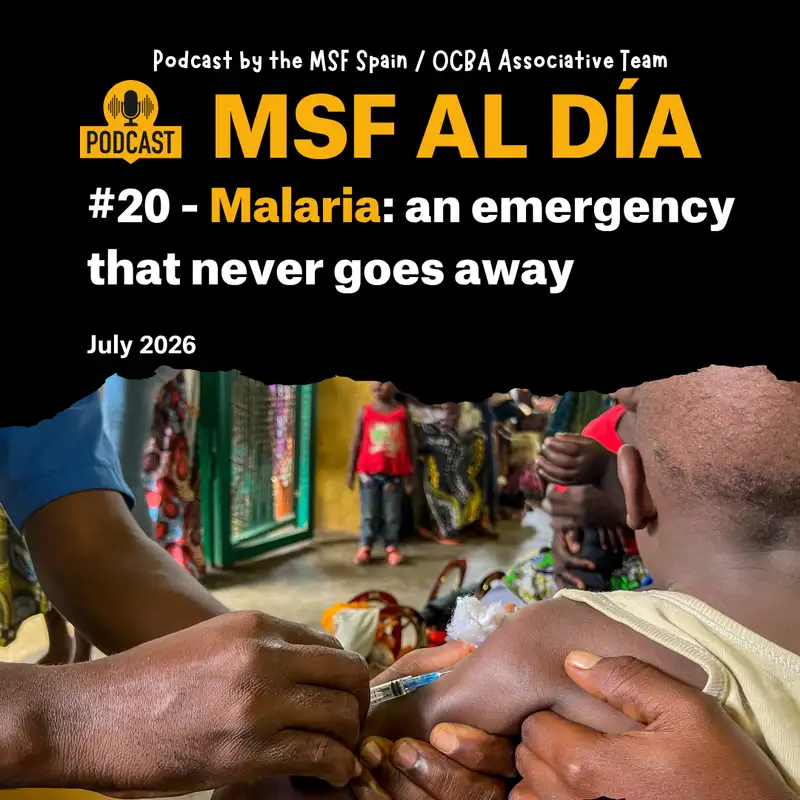
#20 - Malaria: an emergency that never goes away
play Play pause Pause
S3 E20

#20 - Malaria: an emergency that never goes away

play Play pause Pause
Malaria remains a daily threat in many of the places where we work. Although it is a preventable and treatable disease, it continues to cause millions of cases every year and has a particularly severe impact on children under the age of five.

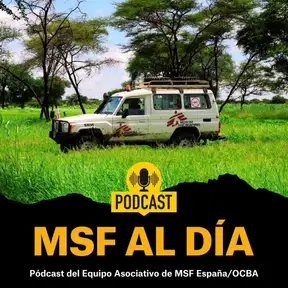
In this new episode of MSF al día, we speak to Nines Lima, vice-president of MSF Spain, and Fran Bartolomé, MSF specialist in international health, tropical medicine and epidemic response. Throughout the conversation, we discuss what we are doing to tackle malaria, the main challenges faced in our projects, existing treatments and the role of innovation, with a section dedicated to the malaria vaccine.

Malaria cannot be treated as a ‘business-as-usual’ disease to which we respond automatically. It remains one of the major threats to life in many of our projects and requires specific plans, coordination, prevention, diagnosis, treatment and a very careful assessment of each individual context.

(Video includes Spanish subtitles)

Episode Video

Creators and Guests

Nuria Espinoza
Host
Nuria Espinoza
Equipo Asociativo de MSF España/OCBA - Comunicación
Francisco de Bartolomé
Guest
Francisco de Bartolomé
Family Physician Doctor at Miguel Hernández University with postgraduate training in tropical medicine at the University of Barcelona and in public health at the London School of Hygiene & Tropical Medicine, with a focus on low- and middle-income countries. After completing the specialization, Fran worked as a hospital emergency physician and in primary health care. He started in MSF in 2010, I undertook my first mission with MSF in South Sudan. With MSF, I have worked primarily on projects in sub-Saharan Africa as a field doctor and medical activities supervisor and coordinator. Subsequently, I worked with the FRS Foundation in Equatorial Guinea, implementing a project supported by AECID to strengthen primary care, health information systems, and epidemiological surveillance. Later, I continued MSF as health advisor in cell 2 of OCB, overseeing Mediterranean migration projects and centers for torture victims, as well as missions in Mauritania, Nigeria, and Bangladesh. Following these operational roles, I shifted to providing technical support within the medical department of MSF Spain, focusing on emergency medicine, epidemic diseases and outbreak response, and tropical medicine—including malaria and neglected diseases. During this recent period, I secured a position as a career civil servant MD, working both at the Ministry of Health’s Directorate General of Public Health and at the International Vaccination Center.
María Ángeles Lima
Guest
María Ángeles Lima
Family Physician doctor at Granada University with Master in International Health and Tropical Diseases in Barcelona-Hospital Clinic. After completing the specialization, Nines worked in different hospitals and Health Centers as a hospital emergency physician and primary health care doctor. She started in MSF in 2001in Somalia and since then has worked in different positions at field level, majorly as emergency coordinator and at HQ level in Sub-Saharan Africa, Asia and Latinoamerica as Tropical Diseases Advisor (focused on Malaria and Neglected Tropical Diseases) at the Medical Department to support field and research projects. She has also been providing trainings for MSF in Emergency Response for capital and field teams in different Missions and PPDs for First Missions. In the past 5 years, Nines is back to clinical work as Primary Health Care doctor in a Public Health Centre in Barcelona combining her duties since the same period as Vice president of MSF Spain, Agora member and International General Assembly Representative.